grundge

Showing posts with label sin. Show all posts

Wednesday, December 18, 2013

Broken: the nature of sin

        I had, repeatedly, cautioned my firefly to be careful while hanging the heirloom ornament on one of the highest branches, so it wouldn’t be disturbed later by excitable and boundless puppy energy.  She hesitated, turning the treasure over in her hand, and assured me that she would be.  Stretching, she reached for a sturdy perch; but the desired branch proved too flimsy.  She pulled it back from the tree, ornament outstretched toward me, and humbly asked that I put it on in her stead.  I lauded her wisdom, smiling while grouping three branches together to support the weight of her prize.  When, without pretense, the ribbon unwound and my haughty hold was compromised.  The ornament fell; six feet, with the sickening, slow-motion plummet that foreshadows the loss to come.  And clattered on the wooden floor.  Pieces fled hither and yon, under the tree skirt and into the living room.  Mouth agape, I turned wide eyes to the firefly.  Hers, shimmering with disappointment, answered my disbelief. 

Broken.


        We had just discussed the inherent irreplaceability of particular things.  We had talked, this ornament nestled safely in its box, about how you can’t go back to certain times, can’t redo certain events, can’t relive certain memories.  The best we can do is try to fix them in the present, mending to the best of our abilities, and learning to muddle through with the cracks and dents our hands have caused.  Or to live without that which was formerly so precious. 

        The firefly’s tears in check, we comforted, and then we did the best we could.  The Officer went into town the next day to procure the right kind of glue.  I adhered flesh to flesh, skin to counter, and dermis to ornament in the process; but eventually the ornament held.  Nonetheless, it remains broken.  The cracks, not visible unless you know where to look, are there.  And they are fragile.  It will require extra care every year, in both packing away and hanging.  There will likely be times that it fractures again, so prone because of the fissures already there. 

For there is nothing I can do to make it all the way whole again.

        It is the condition of human being to live thus.  We are each broken.  Our cracks sometimes visible in the right light, other times, they remain hidden deep within.  We are especially fragile and prone to break in specific, familiar ways.   

        Yet, we were not created so.  Bruce Demarest and Gordon Lewis assert that the Imago Dei remains ontologically[1] “undestroyed” in “all persons, however dominated they may be by the works of the flesh…all humans in their being remain constitutionally image-bearers.”[2]  However, these two learned men assert that all people inherited depravity or hereditary corruption and guilt for Adam’s sin.[3]  They utilize Jesus’ statement in John 8:34 to accommodate their belief:

I tell you the truth,” Jesus said, “everyone who sins is a slave to sin.”

And they affirm that Paul says in Romans 7:5 “in our fallen condition, [human being is] ‘controlled by the sinful nature.’”[4]  Thus, Demarest and Lewis articulate that all of humanity’s slavery to and control by sin illustrates that the sin nature is transmitted from Adam, generationally, to all of human as members of the same race.   

Ray Dunning, though agreeing that all of humanity is sinful, does not agree that in a fallen and sinful state, humanity can retain the Imago Dei.  He points out that the entire New Testament is devoted to the process of salvation, which is the restoration humanity, through Jesus Christ, to the image of God because “man is ‘essentially good but existentially estranged.’”[5]  If this restoration is necessary, then humanity is assumed to have fallen away from rightly bearing the image of God.[6]  Prior to the Fall, there existed between human being and God a filial relationship [a son or daughter relationship].  It is in this unbroken relationship that Adam could reflect the image of God.[7]  However, after the Fall, humanity became sinful, because “sin does not exist independently of human beings,” nor is it “to be regarded as some flawed or defective part of human nature.”[8]  Sin is the perversion of the natural drives within material creation; in action, it is the misuse of the created order, a moral condition of a personal being.[9]  Thus, while sin thwarts God’s purposes, it does not ontologically change the nature of human being. 

                In the end, Demarest, Lewis, and Dunning all agree that the sin nature inherent in each human being does not change his or her ontological composition.  This premise can be extremely important in the communication of the gospel, so that no matter what sin a person has engaged in, nothing makes him, or her, an inherently bad person.  This also translates into the realm of spiritual development; for many Christians continue to struggle with certain temptations or sins after conversion and would likely benefit from the knowledge that they are created “good.”  Finally, for our treatment of fellow human beings, we have to recognize that a person’s sin is not the sum of his/her identity.  Rather everyone should find their identity and worth in Christ; and those who call themselves His followers, ought to see the Imago Dei in the lost, even if the lost cannot.     


                We are all broken; we are all estranged.  But we can be mended.  We can be healed.  We can be made whole.  All by the finished work that started with an infant in a manger.  A Creator God, having made inherently good beings who chose evil and self over relationship, put aside the gravitas of heaven to be born into this fallen world, to live among sinners, to die to restore humanity and all of creation to what it was meant to be. 

This is the truth of Immanuel, God with us.       


Want to know where we've been in this series?  Click the links below for more. 


[1] Existentially
[2] Demarest, Bruce and Gordon Lewis.  Integrated Theology: Knowing the Ultimate Reality of the Living God. vols 1 & 2.  Grand Rapids: Academie Books, 1987.  Volume 2, page 237.
[3] Ibid.
[4] Ibid.
[5] Dunning, H. Ray.  Grace, Faith, and Holiness: A Wesleyan Systematic Theology.  Kansas City: Beacon Hill Press, 1988.  Page 160.
[6] Ibid., page 151.
[7] Ibid., page 157.
[8] Ibid., page 275
[9] Ibid., pages 246, 275.

Thursday, April 18, 2013

The Truth about Sin and the Redeemed

Evangelicals are fond of the ideology that everything is covered by the blood of Jesus.  There’s no sin that his sacrifice can’t atone for.  And this is a good thing, because it’s true.  We evangelicals know that the wages of sin is death; and the death of Jesus, offered once for all, is the payment accepted on our behalf.  The Scriptures abound with this truth.  What I don’t find is a sliding scale of which sin is worse than another.  I find no formula for:

Sin X requires 3 drops of the blood of the Lord, while Sin Y requires 2 whole pints. 

Once you were alienated from God and were enemies in your minds because of your evil behavior.  But now he has reconciled you by Christ’s physical body through death to present you holy in his sight, without blemish and free from accusation ~ Colossians 1:21-22 {emphasis mine}

I cannot find this prescription in Scripture because it is not there.  The truth is that each and every sin is first and foremost an act of rebellion against Almighty God; secondly, it is an act against His creation (self, other person, or nature) of which He has all proprietary rights.  I say this, because what follows is going to bother some people.  Some folks who have worked very hard to maintain as righteous a life as they could, sinning as absolutely little as possible; people who may truly be able to say, “follow me as I follow Christ.”*  But the truth is that no matter who you are, what you or have not done:

Each. Sin. Cost. Precisely. the Same. 

Don’t you realize that those who do wrong will not inherit the Kingdom of God? Don’t fool yourselves. Those who indulge in sexual sin, or who worship idols, or commit adultery, or are male prostitutes, or practice homosexuality, or are thieves, or greedy people, or drunkards, or are abusive, or cheat people—none of these will inherit the Kingdom of God.  Some of you were once like that. But you were cleansed; you were made holy; you were made right with God by calling on the name of the Lord Jesus Christ and by the Spirit of our God.  You say, “I am allowed to do anything”—but not everything is good for you. And even though “I am allowed to do anything,” I must not become a slave to anything. ~1 Corinthians 6:9-12 {emphasis mine}

 Each one cost the very life blood of God’s Only Son, Jesus Christ.  All of it.  Whether you’ve taken a stapler from work, or you’re the head of Enron.  Whether you’ve held anger in your heart towards your parents/spouse/child, or you’ve committed serial murder.  Whether you’ve only looked at the Sport’s Illustrated bikini models that one time, or your internet stable would be Solomon’s envy.  Whether you’ve stared at the ground trying to ignore the homeless person asking for help, or you’ve stocked piled humanitarian supplies to sell on the black market to the highest bidder.    

Any shade of sin cost Christ everything. 

And He paid it.  For Love.  For Hope.  For Healing.  For Restoration.   

If you have not accepted Christ’s sacrifice on your behalf, dearest one, I pray that you that do.  For there is nothing that you can do; no benevolence great enough to erase the sin-DNA coursing through all humanity, no deed good enough to tip the scales of righteousness in your favor.  There is only the blood of Jesus.

If you have accepted this gift, beloved, I am rejoicing for you.  For as one prone to fallenness, but for the grace of the Father, the love of the Son, and the presence of the Spirit, I am so delighted that you and I have been saved from ourselves and our sins. 

From here, followers, we must remember that every sin cost Christ the same.  So that we when look at others, we cannot call them by the label their sin mars them with.  For in Christ, there are no murders, no thieves, no fornicators, no liars, no abusers, no drunks. 

In Christ, there are only the redeemed saints. 

Saints who, while rejoicing in their new identities, must always recall from whence they came. 

Once you were dead because of your disobedience and your many sins.  You used to live in sin, just like the rest of the world, obeying the devil—the commander of the powers in the unseen world.  He is the spirit at work in the hearts of those who refuse to obey God.  All of us used to live that way, following the passionate desires and inclinations of our sinful nature. By our very nature we were subject to God’s anger, just like everyone else. ~Ephesians 2:1-3 {emphasis mine}

An abortionist, forgiven by Christ, is the same as the little boy or girl who gave their lives to the Lord at 4, only  ever lying to his/her mom.  A terrorist, redeemed by Jesus, is the same as the missionary, bringing God’s Word and love to people the world over.  A pimp, a prostitute, or a john, saved by the Lord, is the same as Chuck Swindol, Beth Moore, or Billy Graham.

At the foot of the cross, we are all the same – sinners, in desperate need of our Savior.

This truth, dear friend, frees us to minister with Love.  Because we know, we are intimately familiar with, the sin ghetto in which all humanity struggles – until accepting Jesus’ rescue.  The truth of who we were, joined with the truth of who we are now lets us embody our new identity as made-righteous-in-Christ, so that we may shower His grace and love upon the lost and hurting in this dark world.  It allows us to use our hands, our words, and our hearts on behalf of God’s kingdom in the lives of the people He came to save.  The people who are the same as you and I were, not so very long ago.  The only thing that separates us now is our acceptance of the grace and love of our Lord, Jesus Christ.  May we bridge that gap with our outpouring of His love into the desperate and hopeless world, to which we have been called as ministers of Christ’s grace. 

~Amen


*{Before venturing further, I will say that I am so very thankful for people who live this way.  May you continue to be a beautiful light pointing to the Christlikeness towards which each of us should strive!}


Tuesday, July 17, 2012

Who She Was...and Who She Wasn't

The Samaritan Woman at Jacob’s Well, Day 2
A Video Blog


Enjoying this study?  Here's a link to articles in this series: The Women Who Knew Jesus

 
Bibliography:

John Piper, “God Seeks People to Worship Him in Spirit and Truth (John 4:16-26),” Bethlehem Baptist Church, April 8, 1984.  http://www.soundofgrace.com/piper84/040884m.htm.

Cohick, Lynn H.  Women in the World of the Earliest Christians: Illuminating Ancient Ways of Life.  Grand Rapids: Baker Academic, 2009.
Swidler, Leonard.  “Jesus in His Encounter with Women,” AFER.  13 (1971): 290-300. 

Tuesday, July 3, 2012

Just so we're clear...

(a type of worship)


It is historically documented.  It is intellectual folly to deny that a first century, Palestinian Jew by the name of
     Jesus
was crucified by the Roman government.  There is no scholarly debate: Jesus was a man.  Fully, completely, no-way-around-it, human, male.  This man, worshiped over 2,000 years later, could not then, nor ever have been a woman.

As a man, Jesus was a Jew.  He was raised in an orthodox Jewish home.  He practiced the Jewish religion (yep, I said that Jesus was religious.  Which, in the anthropologistic and historical sense implies that he practiced his religion…, well, religiously).  He followed the Mosaic Law to the letter.  Not one iota was ignored, not one minutia disobeyed.  His lineage was carefully documented to prove that he was the answer to eons of prophecy.  He was educated in the Hebraic traditions and scriptures; and he observed all the festivals and Sabbaths as one who understood their true purpose.  He taught with authority and corrected the misunderstandings of the mortals he came to save.  Of the Israelite leaders, he expected much.  To those on the fringe or outside the faith, he offered a way in.         
Jesus hung out with sinners and outcasts; ate with them, walked with them, talked and laughed and wept with them.  He saved them; he forgave them; he loved them.

                HE WAS NOT ONE OF THEM.

Jesus was Divine.  Before the universe was formed, before humans drew breath, before time began and after time ends he will continue to be always and forever Divine.  One with the Father and Holy Spirit in perfect and complete communion. 
Jesus came to earth, while sinners were sinning, to rescue humans who didn’t know they needed saving.  He died in the stead of every sinner who ever was or ever will be.  But only,
     Only
if the sinner chooses to trade his or her wickedness for Jesus’ all-encompassing righteousness.  To trade their own, impending and eternal torment, for his atoning death on the cross.  This choice is always in the heart of the sinner.  Like a marriage proposal, anyone can accept or reject this love.  Unlike a proposal, this love is offered every moment of every life.  Until the moment when life is over.  Or until that soul grows so hard from scratching out a life in the wilderness of death and constant pain, that Jesus [whom I picture weeping bitterly, as he did over Jerusalem just prior to his crucifixion] says to that sinner, “your will be done.” 

To be completely clear, Jesus was everything the Holy Scriptures say he was.  Jesus, the Promised Savior, the Only Son of the Almighty God, will never be a sinner.  He came to save sinners.  He died to redeem sinners.  He lives to give Love to sinners.  If we would but accept it.    
He was, in a specific and tangible and documented portion of linear time, God housed in flesh.  He was Eternity in temporal form.  He is the Healer of the broken, Redeemer of the damned.  He is the One who loves each sinner so much that He would trade his life, his oneness with the Eternal Almighty LOVE Itself, for the sake of that one sinner to be welcomed into His Father’s house. 

But He is not to be made in our image.  He is not a domesticated kitten, upon whom we may assert our ideals or morals or compunctions.  Our culture does not dictate, any more than the ancient Hebraic or Hellenistic cultures which comprised his earthly context, his will.  Jesus’ will was always that of the Father.  And the Father’s will does not deviate from scripture.  Regardless of what our favorite authors may tell us.  Or how we feel, as one-third-world dwellers.
Jesus the Christ is the Lion of Judah, who will return not as prophet or pacifist, but as King of Kings and Lord of Lords.  Robes dipped in blood; Warrior for His Father’s kingdom, who will reclaim all that evil has stolen.   And He will win.

For LOVE, true and honest and just LOVE, wins. 
     For His glory and Kingdom and Power are forever.

Amen.


Please leave a comment below if you have any questions regarding this theology. 
 I am happy to supply scripture references (as well as secular and scholarly). 


John Mark McMillan's "Death In His Grave"
 
 
Enjoying this study?  Here's a link to other articles in this series: The Women Who Knew Jesus

Friday, April 6, 2012

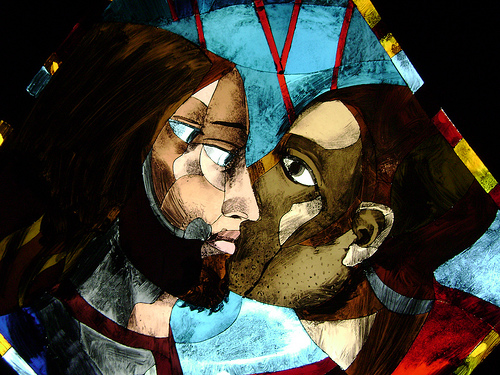
Judas' Kiss


It’s a dying world.  Rotting.  One could get lost forever in this darkness. 

The proof is in the media; whatever brand you choose.  The headlines alone cause me to question so much…

The week, the Officer has seen things, perpetrated against the most innocent, things that won’t make it to the front page; it makes me wonder how anyone can hope in a place so thick with evil. 

Yet, there was a time not so long ago that I kept company with this ever-present darkness.  Matched its step as a friend.  Breathed the same tempo, like a lover.  Synchronized my heart with this evil that has overcome the world.  Believed the lies, veiled my eyes to truth, and walked deep and long into the wilderness.    

It is always Good Friday that recalls this waywardness in me.  Its recollection brings sorrow.  The remembrance of what my place in the King’s house actually cost.  The price Christ paid, to wade into my desolation; and rescue me from my self-wrought destruction.      

But in meditating on the truth of the cross, hope is found.  There is nothing that the cross doesn’t cover.  Nothing too dark, too weighty, too horrible for Jesus to forgive. 

His blood is enough.  

For me.  For you.  For anyone who asks, who turns their face from the dark and asks to be let into the light.  The ransom has been paid.  You are free, if only you so desire. 

In order for the greatest act of creation to occur, the most grievous depths of despair and darkness had to be reached first.  Death.  Grief.  Separation.  Crucifixion. 

Then life.  Glorious, miraculous life.  For this is the hope and promise of the resurrection.